
THE COMPASS PRODUCT OPERATING MODEL
Four pillars. One system.
A complete operating model for Product Managers.
The CPOM was built from 25+ years of product and software practice. It's not borrowed from a watered-down framework or a repackaging of agile. The CPOM was built from the ground up for the work Product Managers actually do every day.
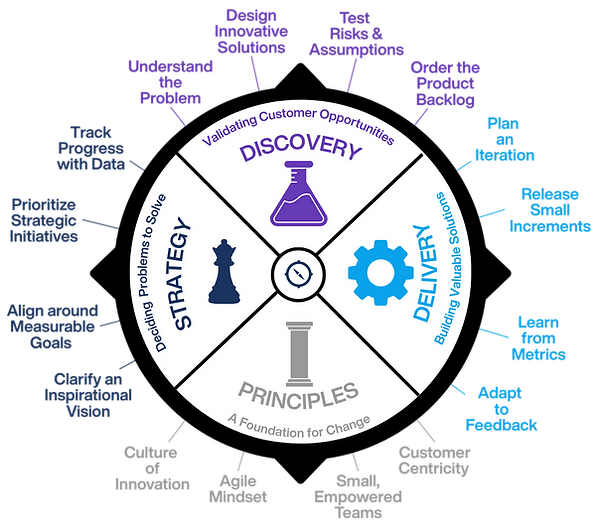
The four pillars feed each other.
Principles set the rules.
Strategy decides the bets.
Discovery proves the bets are real.
Delivery makes them real.
THE FOUR PILLARS
One pillar is a discipline. Four pillars are an operating model.
Each pillar is a complete body of practice. None of them survives long without the other three.
Principles
A Foundation for Change
What a Product Manager must believe to do the work well, and what to refuse to do regardless of pressure. Principles come before process. Without them, every framework collapses under the weight of stakeholder requests.
-
Customer Centricity: Focus relentlessly on customer pain and needs
-
Small, Empowered Teams: Enable autonomous teams to move fast
-
Agile Mindset: Embrace iterative delivery and adaptation
-
Culture of Innovation: Foster learning over perfectionism
Strategy
Deciding Problems to Solve
Guidance about where to play, where not to, and the evidence required before the team commits its critical engineering capacity. Strategy is not a generic PowerPoint deck. Strategy is the innovative bets that survive contact with reality.
-
Clarify an Inspirational Vision that rallies the organization
-
Align around Measurable Goals using OKRs
-
Prioritize Strategic Initiatives that deliver maximum business value
-
Track Progress with Data to make informed decisions
Discovery
Validating Customer Opportunities
The skill most Product Managers were never taught, and the one AI cannot replace. Customer interviews, problem framing, and prototypes that prove the idea before it ships. The pillar that narrows the distance between delivery speed and product value.
-
Understand the Problem through customer research and empathy
-
Design Innovative Solutions that address real pain points
-
Test Risks & Assumptions with rapid experiments and MVPs
-
Order the Product Backlog based on validated customer needs
Delivery
Building Valuable Solutions
The part most teams already do. Made faster, safer, and more honest by the three pillars upstream. With principles, strategy, and discovery in place, delivery stops being heroic and starts being predictable. Teams are freed to do what they do best.
-
Plan an Iteration with a clear, focused intent
-
Release Small Increments to get fast feedback and deliver rapid value
-
Learn from Metrics to understand actual usage and immediate customer impact
-
Adapt to Feedback and continuously improve
IN DEPTH
How the Compass Product Operating Model actually works.
The pillars above are the shape of the model. What follows is how it operates in real product organizations - the connecting tissue, the cadence, and the decisions it forces a team to make.
Most organizations that struggle with product development are not missing a process. They are missing a system. A process tells people what to do and in what order. A system creates the conditions for the right things to happen naturally, because everyone understands the purpose of each part and how it connects to everything else. The Compass Product Operating Model is a system. That distinction is the reason it works when other approaches do not.
The most common mistake when first encountering the CPOM is reading the four pillars as steps. Principles first, then Strategy, then Discovery, then Delivery. That reading is wrong, and following it produces the same problems the model is designed to solve. The pillars are concurrent and interdependent, and that interdependence is where the model's power actually lives.
The Loop Is the Mode
Strategy, Discovery, and Delivery run continuously, with each informing the others in real time. Principles are not Step 1. They are the operating context inside which everything else functions. Remove them, and the other three pillars operate under constant resistance.
-
Teams that cannot act on what they learn
-
Strategies that do not change when the evidence says they should
-
Delivery that ships without anyone measuring whether it worked.
Think of the three active pillars as a feedback loop rather than a pipeline. Strategy defines which problems are worth solving. Discovery investigates those problems, tests the assumptions behind them, and generates evidence about which solutions are likely to work. Delivery ships those solutions incrementally and generates real-world data about whether they actually do. That data feeds back into Strategy, either confirming the direction or changing it. The loop runs continuously. There is no finish line, only better and faster information.
This is why incremental delivery matters beyond the arguments about reduced risk. Increments create feedback while big-bang releases create silence and apathy. When a team ships in small increments and measures the results, they continuously update the information that feeds back into Discovery and Strategy. The model is self-correcting in a way that long-cycle delivery never can be.
What the Model Actually Demands
The Compass Product Operating Model is not complicated to understand, but it is demanding to operate.
It requires honesty about what is actually known versus assumed. Most product backlogs are full of features that exist because someone important wanted them, not because customer evidence supported them. The model surfaces that gap immediately, preventing organizations from looking away.
It requires honesty about authority. Empowered teams need real authority. If Discovery finds something that contradicts the roadmap, the team needs to be able to act on that finding without routing it through a committee that was not in the customer interviews. Organizations that say they want empowered teams but approve every decision from the top will find the model does not work.
It requires honesty about speed. The pressure to ship is real and constant. The temptation to skip Discovery to move faster is one of the most predictable failure modes in product development, and in the AI era, it has become more significant. AI tools have dramatically accelerated delivery. That speed raises the cost of poor Discovery. Speed in the wrong direction is not an advantage. The organizations that operate the CPOM well are the ones that are most honest about what it requires.
THE COMPLETE MODEL
The whole operating model is in the book.
190+ pages. The four pillars in depth. Detailed examples. Engaging exercises. A free Google Sheets workbook.
Not ready yet? Start with the free 9-page Discovery Guide.
